Assistant Curator Emily Rosevear investigates the realities and representations of motherhood in the ancient Mediterranean world.
Since giving birth to my son in January, between the endless feeding, nappy changes and trying to convince him that he really does need that nap, I have gained a newfound respect for mothers everywhere. As a curator of a museum of classical antiquities, it is perhaps rather fitting that my experience would get me thinking about what motherhood was like for women in the ancient world. Did they also stare at their newborn babies for hours, worry at every sniffle, and celebrate every small milestone like it is an Olympic victory?
While the world looked very different for women in antiquity, there are some aspects of motherhood than transcend time. For women in the ancient world, motherhood was what they had been trained for their whole lives. We know that some girls were given the opportunity for a formal education, but for most young women their education revolved around preparing themselves for marriage and motherhood. Feeling isolated and cut off from a career they’ve worked so hard to achieve while home caring for a baby, is probably a feeling that is reserved just for modern day mothers. Ancient woman also had the advantage of not having to contend with the pressures of social media and strangers on the internet trying to convince you that their strict wake window schedule makes their baby sleep better at night. However, I’m sure the women of the ancient world also faced many challenges both physical and mental as they embarked on this life changing experience.
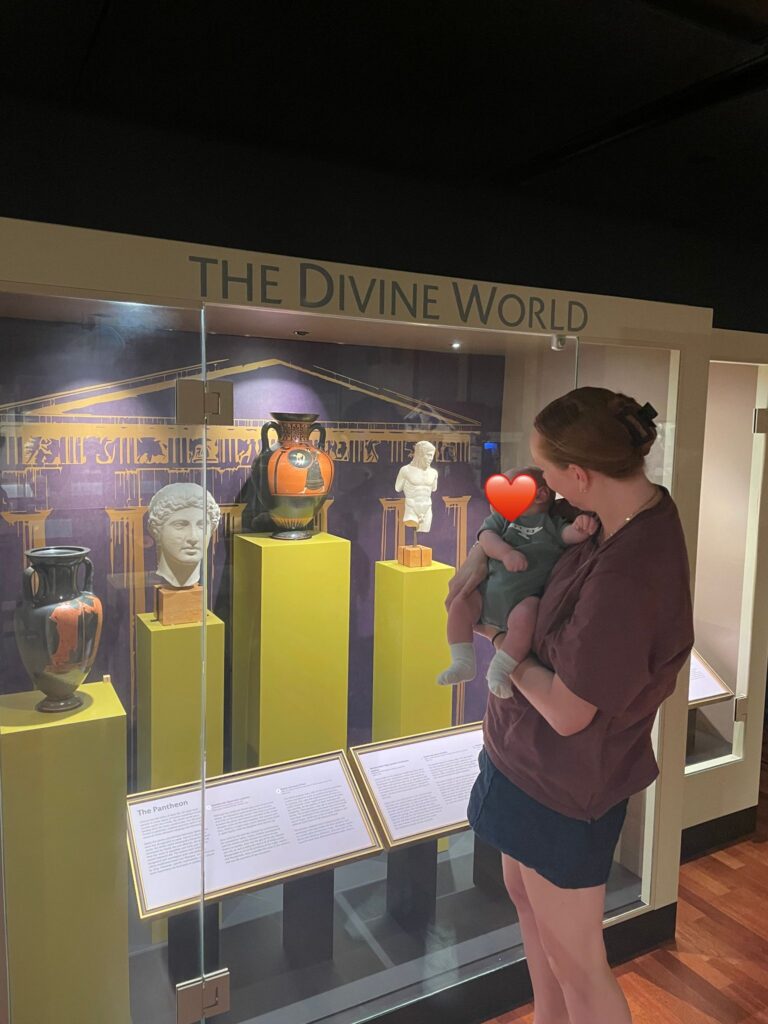
Mothers in Antiquity: The realities of pregnancy and childbirth
Our knowledge of childbirth and pregnancy in the ancient world is mediated by male authors. Outside of a few inscriptions on funeral monuments such as that of Scribonia, a Roman midwife, no first-person accounts of childbirth or pregnancy exist. [1] Euripides gives us a female perspective through the voice of Medea who famously says:
‘How wrong they are! I would rather stand three times with a shield in battle than give birth once.’ [2]
But this is far from a personal perspective, as it is mediated through a male author and can hardly be considered the view of all ancient women. We do know that the task of caring for women during their pregnancy and childbirth was largely considered to sit within the female sphere and knowledge was passed down from one generation of women to the next. [3] In the ancient world women were primarily thought of as wives and mothers, with very few options for paid employment. Midwifery was one of the few professions for which women in Greek society could be paid. [4] Midwives, or obstetrices as they were known in the Roman world, cared for women by applying principles of rational medicine to pregnancy and childbirth. [5]
Childbirth in ancient times was associated with a high risk to both the child and the mother, with substantial infant and maternal mortality. It has been estimated that the risk of maternal mortality was as high as seventeen out of a thousand for women in antiquity, while in modern countries today the risk is much lower, sitting at 0.1 per thousand women. [6] Ancient literature provides us with a number of examples of the dangers involved, such as Caesar’s daughter Julia who died in childbirth. Pliny the Younger reports that both daughters of his friend Helvidius died while giving birth. [7] Poor hygiene and sanitation, and a lack of understanding around nutrition, are just some of the environmental factors involved in creating such a high risk to women. [8]
Common pregnancy symptoms plagued women of the ancient world in the same way they affect pregnant women today. During what was known as the pica phase (approximately 40 days from conception) ancient writers noted that a woman might experience nausea, dizziness and cravings for extraordinary food such as ‘Earth, charcoal, tendrils of vine, unripe and acid fruit.’ [9] Thankfully my own experience did not have me craving similar items.
For women giving birth in the ancient world there was little pain relief available, and little knowledge of infection and basic hygiene. But despite the high rates of mortality in cases of uncomplicated births, women could manage with the assistance of only a knowledgeable family member or midwife. Techniques still used today were employed such as massage and breath control, with Soranus, a Greek gynecologist and obstetrician, telling us that women should ‘press their breath’ when the pains are most acute. [10] A task I can attest is much easier said than done. I’m also not sure that I agree with ancient doctor Celsus who wrote that sneezing relieves a difficult labour.[11]
Postnatal care has also come a long way and I’m grateful to be able to report that popular ancient remedies for caring for mothers after birth including drinking dried dung or asses’ milk are no longer used.[12] It does however, give me greater appreciation for the bland (and what I deemed at the time downright awful) food I was given during my own hospital stay.
Despite the challenges and dangers faced by ancient women we do have records of ancient birth notices that express the joy associated with childbirth. A far cry from the social media announcements many use today, excavations in Pompeii have revealed examples of graffiti recording births. One such example reads: ‘Our daughter was born early in the evening on Saturday, August 2.’ While another says: ‘Announcing the birth of Cornelius Sabinus.’ Cicero also records his pleasure at the birth of a son in a letter to Atticus writing, ‘Please be informed that I have been blessed with a little son. Terentia is doing well.’ [13] These examples show that the arrival of a heathy child was just as joyous to parents in ancient times as it is today.
Mothers in Mythology: Both good and bad examples
While I can almost be certain that the mothers of the ancient world were not awake at 2 am frantically googling ‘normal newborn sleep noises’ they did have a few examples of motherhood to look to and even some goddesses to turn to for guidance within their pantheon of gods.
For the ancient Greeks and Romans many of their goddesses had connections to childbirth. Even Artemis, a goddess known for her vow of virginity, was associated with it and is said to have assisted her mother by delivering her twin brother Apollo. Given the dangers involved in pregnancy and childbirth it is hardly surprising that many of their deities were connected to this phase of life.
While Hera is perhaps not the best example of a caring mother, (throwing your child from Mount Olympus should certainly be frowned upon), she was still an important goddess to the women of the ancient world. Queen of Mount Olympus, she was widely worshiped as the goddess of marriage. She has been given a bad reputation as the jealous and bitter wife of Zeus, but under her title Eileithyia (who is sometimes worshiped as a goddess separate to Hera) she oversaw childbirth. While getting on her bad side as a pregnant woman could be rather painful, for reasons I will go into shortly, she was known to be motherly. She did attempt to breastfeed the hero Herakles in order for him to receive her divine breastmilk. However, whether she was a willing participant depends on the version of the myth you read. Unfortunately for Hera the young hero bit down on her breast and in her surprise, she threw him from her chest spraying breast milk across the sky, which formed the milky way. Anyone who has had a baby suddenly pull away while feeding can surely sympathise with Hera’s pain.
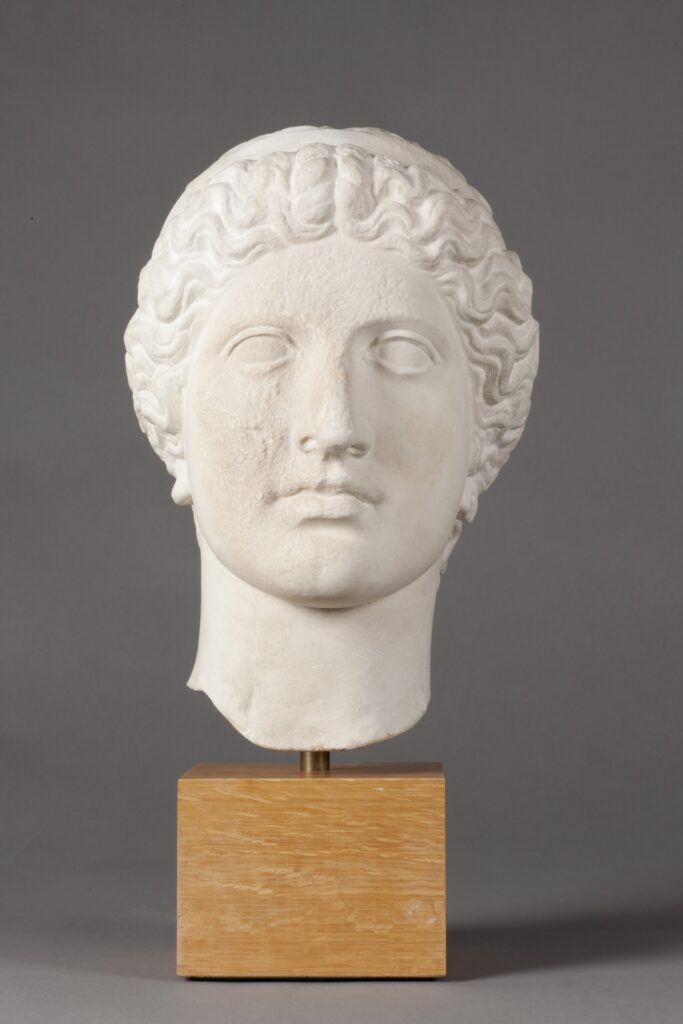
There were however, a number of other notable mothers in myth that women could look to for guidance, such as Gaia the earth mother and personification of the earth. Cybele was another goddess worshiped for her connection to motherhood, (more on her later), while Rumina was the Roman goddess tasked with protecting breastfeeding mothers and infants.
Demeter, goddess of the harvest and agriculture, gives us an example of a devoted mother. Unlike Hera she didn’t toss her child off Mount Olympus, but when her daughter Persephone was abducted into the Underworld by Hades, she abandoned her responsibility for the harvest in a desperate search for her daughter, causing a famine. Like Hera she is also linked to childbirth and marriage.
Leto is a lesser-known figure in ancient myth but one who was also worshipped as a mother goddess. One of the Titans, Leto was impregnated by Zeus, and his jealous wife Hera commanded Gaia to deny her a place to rest and give birth. Leto was forced to travel around the Greek word heavily pregnant until eventually the floating island of Delos provided her with the sanctuary she needed to birth her twins, Apollo and Artemis.
For any pregnant woman, Hera is a goddess you want to have on your side as she had a reputation for denying women the opportunity to give birth. Not only did she try to prevent Leto from giving birth to her twins, she also interfered in the birth of the Greek hero Herakles. According to myth, Herakles’ mother Alcmene was prevented from giving birth when Hera sent the goddess Eileithyia to sit outside her bedchambers with her legs crossed in an attempt to prevent this new son of Zeus from being born. Alcmene laboured for seven days and seven nights before one of the women attending her was able to trick Eileithyia into standing up, allowing Alcmene to deliver her twin boys. Any woman unfortunate enough to experience a long labour may have started to question what she had done to offend Hera.
Mothers in the Logie Collection: Protectors and good luck charms
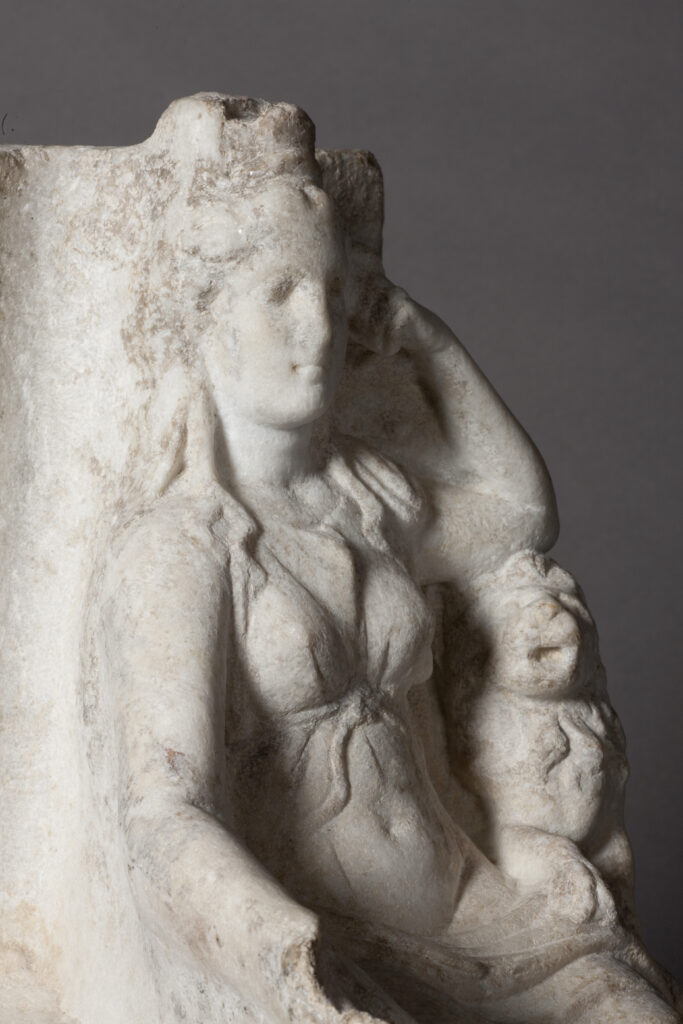
Within the Logie Collection examples of motherhood can be found amongst the artefacts, such as this statuette of the goddess Cybele who was known as the Magna Mater (Great Mother). A representation of motherhood, here she can be seen in her role as Cybele Tristis, sad or mourning Cybele. This is a rare representation of the goddess, as there are only twelve known depictions of her in a state of mourning. Originally a Phrygian goddess from Asia Minor (modern day Turkey), she gained a following throughout much of the ancient world before her cult was introduced to the Romans in the 3rd century BCE. This statuette would likely have been used in a funerary context with Cybele acting as a protector of the dead, drawing an interesting connection between mothers and protection.
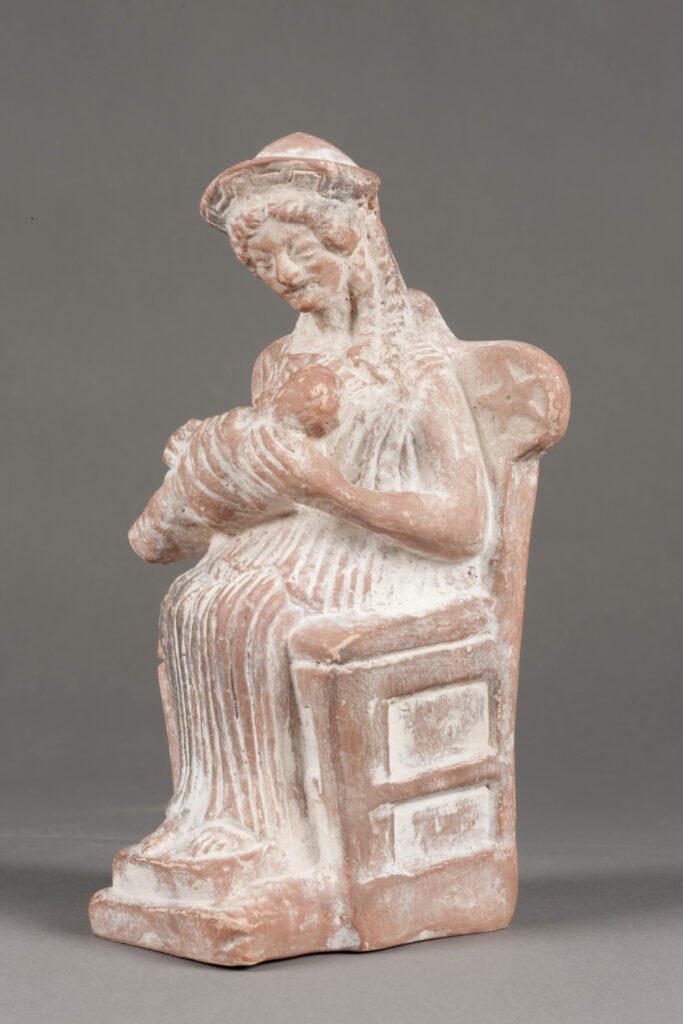
As pregnancy and childbirth was so central to the female experience it is unsurprising that votive offerings of female genitalia, breasts, and statuettes of mother goddesses and miniature statutes of swaddled babies have been found across countless temple sites. [14] One statuette from the Logie Collection is a cast replica of a terracotta figurine of a seated woman holding a child. The original was likely used as a votive offering. Perhaps it was used as a request to the gods for a safe birth or for a mother and child to recover from illness. Or perhaps it was used as an attempt to get on the good side of Hera! The original figurine was found in Anthidona (Anthedon) in Boeotia, Greece and dates to the 5th century BCE. It can now be found in the National Archaeological Museum in Athens, Greece.
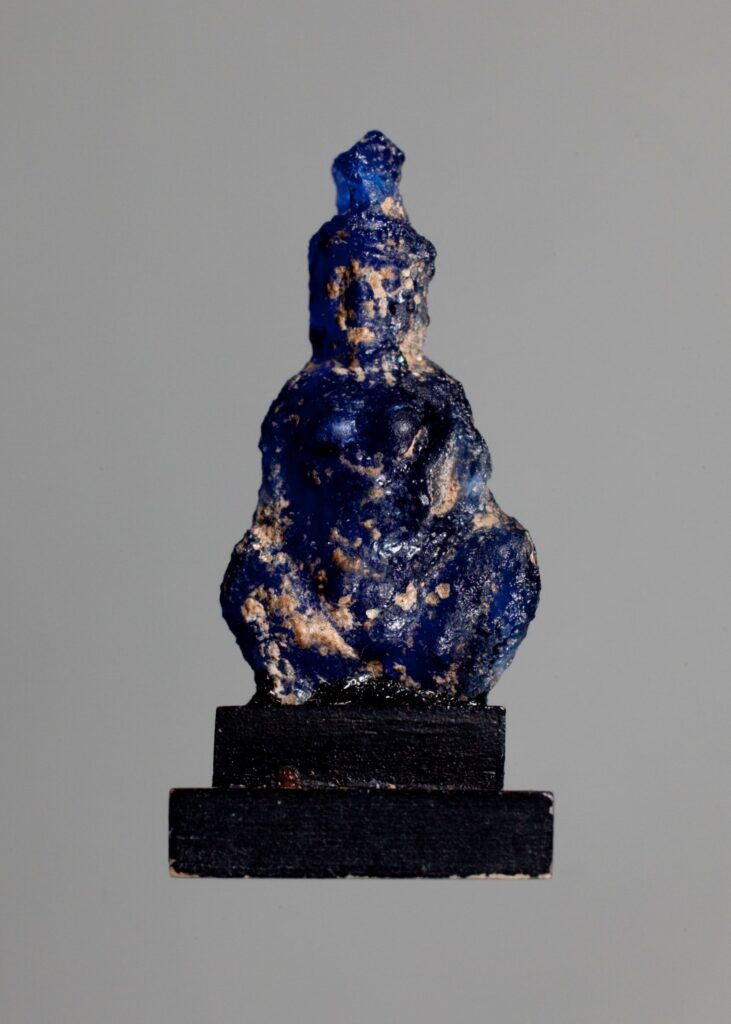
Similar to votive offerings, women may also have found comfort in wearing amulets to assist with birth. Many amulets were made from perishable materials, but examples from Roman Egypt made from durable haematite stone have been discovered. [15] In the Logie Collection this dark blue glass amulet serves a similar purpose, likely worn by women during childbirth. It depicts the Egyptian goddess Heket, goddess of childbirth. The goddesses’ hands are clasped over her belly, and she wears an elaborate frog-shaped headdress, which doubles as a point for hanging the amulet. Heket is often shown as a frog, or as a woman with a frog’s head. Frogs were associated with regeneration and fertility, since they seemed to generate spontaneously from the mud along the Nile after the floodwaters receded.
Conclusion
While mothers today have access to better health care, pain relief, and far more hygienic conditions than the women of the ancient world, there are still some aspects to motherhood that I think are universal across time. The love we have for our children, the excitement to announce their arrival and the desire to protect them in any way that we can. While pregnancy and childbirth have become much safer, the challenges of sleepless nights and learning to understand your baby’s needs remains the same for many mothers.
Without any first person accounts we can’t be exactly sure what the experience was like for women in ancient times. What we do know is that mothers were an important part of ancient society – we just have to look at the number of mothers included in ancient myth to know that the famous Greek and Roman gods and heroes couldn’t exist without them.
Emily Rosevear currently works at the UC Teece Museum as the Assistant Curator. She is a graduate of the University of Canterbury having completed her undergraduate degree in Classics and History, followed by a Masters Degree in History. She is also a proud mum to her four month old son, Theodore.
FOOTNOTES:
[1] Laurence Totelin, Call the (Roman) midwife, History Extra. Accessed May 22, 2026. https://www.historyextra.com/period/roman/childbirth-ancient-rome-empire-mothers-midwives-how-babies-born/
[2] Euripides, Medea, 250.
[3] Christian Laes, “The Educated Midwife in the Roman Empire an Example of Differential Equations.” Hippocrates and Medical Education : Selected Papers Presented at the XIIth International Hippocrates Colloquium, Universiteit Leiden, 24-26 August 2005, 276
[4] Najla Barnawi, et al., “Midwifery and Midwives: A Historical Analysis,” Journal of Research in Nursing and Midwifery 2 (2013): 114-121.
[5] Donald Todman, “Childbirth in Ancient Rome: From Traditional Folklore to Obstetrics,” Australian and New Zealand Journal of Obstetrics and Gynaecology 47, no. 2 (2007): 82.
[6] Laes, “The Educated Midwife in the Roman Empire,” 265-266.
[7] Todman, “Childbirth in Ancient Rome,” 82.
[8] Ibid, 84.
[9] Ibid, 83.
[10] Totelin, Call the (Roman) midwife, History Extra.
[11] Celus, De Medicina, 2.8.
[12] Pliny the Elder, The Natural History, 28.77.
[13] Todman, “Childbirth in Ancient Rome,” 82-83.
[14] Laes, “The Educated Midwife in the Roman Empire,” 265..
[15] Totelin, Call the (Roman) midwife, History Extra.
BIBLIOGRAPHY:
Barnawi, N., Richter, S. and Habib, F. “Midwifery and Midwives: A Historical Analysis.” Journal of Research in Nursing and Midwifery 2 (2013): 114-121.
Celus. De Medicina. Edited by W. G. Spencer. Cambridge, Massachusetts. Harvard University Press. Accessed June 4, 2026. http://data.perseus.org/citations/urn:cts:latinLit:phi0836.phi002.perseus-lat1:2.8
Euripides. Medea. Edited by David Kovacs. Cambridge. Harvard University Press. Perseus Digital Library. Accessed May 25, 2026. http://data.perseus.org/citations/urn:cts:greekLit:tlg0006.tlg003.perseus-eng1:214-251
Laes, C. “The Educated Midwife in the Roman Empire an Example of Differential Equations.” Hippocrates and Medical Education : Selected Papers Presented at the XIIth International Hippocrates Colloquium, Universiteit Leiden, 24-26 August 2005. Accessed May 22, 2026. https://doi.org/10.1163/ej.9789004172487.i-566.75.
Pliny the Elder. The Natural History. Edited by John Bostock. Accessed June 4, 2026. http://data.perseus.org/citations/urn:cts:latinLit:phi0978.phi001.perseus-eng1:28
Todman, D. “Childbirth in Ancient Rome: From Traditional Folklore to Obstetrics.” Australian and New Zealand Journal of Obstetrics and Gynaecology 47 (2007): 82-85.
Totelin, Laurence. Call the (Roman) midwife, History Extra. Accessed May 22, 2026. https://www.historyextra.com/period/roman/childbirth-ancient-rome-empire-mothers-midwives-how-babies-born/